Bienvenue chez Mariocraft!
Redécouvrez Super Mario Bros. Jouez et creez vos propres niveaux. Partagez-les avec vos amis. Le niveau avec le plus de visites gagne!
Conçu pour iPad, mais aussi jouable sur un ordi (←, →, z, x).
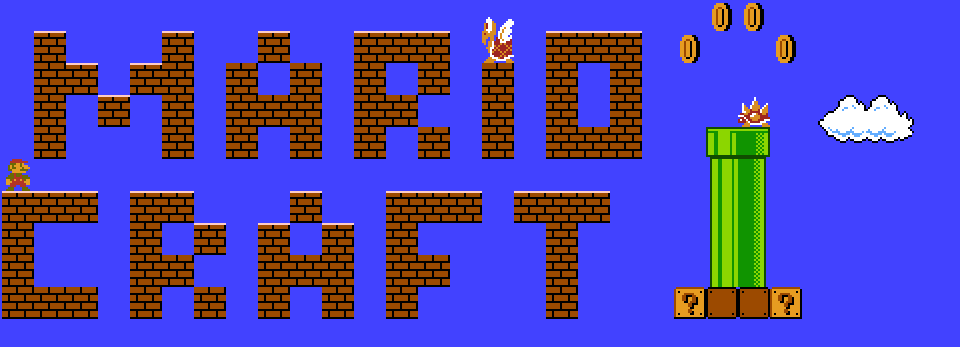
Redécouvrez Super Mario Bros. Jouez et creez vos propres niveaux. Partagez-les avec vos amis. Le niveau avec le plus de visites gagne!
Conçu pour iPad, mais aussi jouable sur un ordi (←, →, z, x).




Discussion
Do Wanna PlayMariocraft
Or Not?
YAY
BYE BYE GAME...
and How do I get To it????
Notice: I'm New to this.
and How do I get To it????
Notice: I'm New to this.
Ol
facebook fta55555
facebook fta55555
a
a
a
a
aa
a
a
a
a
aa
ddd
ddd
ddd
a
a
?????
howwwwwwwwwwwwwwwwwwwwwwwwwwwwwwwwwwwwwwwwwwwwwwwwww
spiney on bg: O-O
me: GOOOOOOOO F*** yourself
The Super Mario games are set primarily in the fictional Mushroom Kingdom, typically with Mario as the player character. He is usually joined by his brother, Luigi, and often by other members of the Mario cast. As platform games, they involve the player character running and jumping across platforms and atop enemies in themed levels. The games have simple plots, typically with Mario and Luigi rescuing the kidnapped Princess Peach from the primary antagonist, Bowser. The first game in the series, Super Mario Bros., released for the Nintendo Entertainment System (NES) in 1985, established the series' core gameplay concepts and elements. These include a multitude of power-ups and items that give the character special powers such as fireball-throwing and size-changing.[2]
The Super Mario series is part of the greater Mario franchise, which includes other video game genres and media such as film, television, printed media, and merchandise. More than 380 million copies of Super Mario games have been sold worldwide, making it the fifth-bestselling video game series, behind the larger Mario franchise, the puzzle series Tetris, the Pokémon video games, and first-person shooter series Call of Duty.[3]
Gameplay
This section needs additional citations for verification. Please help improve this article by adding citations to reliable sources in this section. Unsourced material may be challenged and removed.
Find sources: "Super Mario" – news · newspapers · books · scholar · JSTOR (December 2021) (Learn how and when to remove this message)
The objective of the game is to progress through levels by defeating enemies, collecting items and solving puzzles without dying. Power-up use is integral to the series. The series has installments featuring both two and three-dimensional gameplay. In the 2D games, the player character (usually Mario) jumps on platforms and enemies while avoiding their attacks and moving to the right of the scrolling screen. 2D Super Mario game levels have single-exit objectives, which must be reached within a time limit and lead to the next sequential level. Super Mario Bros. 3 introduced the overworld, a map of nonlinear levels that branches according to the player's choice.[4] Super Mario World introduced levels with multiple exits.
3D installments in the series have had two subgenres: open world exploration based games and more linear 3D games with a predetermined path.[5] Levels in the open world games, 64, Sunshine and Odyssey, allow the player to freely explore multiple enclosed environments in 360-degree movement. As the game progresses, more environments become accessible.[6] The linear 3D games, Galaxy, Galaxy 2, 3D Land and 3D World, feature more fixed camera angles and a predetermined path to a single goal.
Playable characters
The series often features the option to play as characters other than Mario, usually Luigi. Earlier games have offered an alternating multiplayer mode in which the second player controls Luigi on their turn. Luigi is often only playable by player one in a second, more challenging iteration of the base game, such as in The Lost Levels, Galaxy 2, New Super Luigi U and the special worlds in 3D Land; these feature lower gravity and reduced friction for Luigi. Later games allow four player simultaneous play. Playable characters other than Mario and Luigi have included Toads, Peach, Yoshi, Wario, Rosalina, Miis, Toadette, Nabbit, Daisy, and Bowser Jr. Characters are sometimes differentiated by special abilities. Super Mario Maker includes costumes that depict many more characters (Super Mario Maker 2 includes only a Link costume).
Power-ups and transformations
Super Mushroom, as depicted in New Super Mario Bros. U – UGO described it as "the quintessential power-up".[7]
Mushroom power-ups appear in almost every Super Mario game. The most iconic of these is the Super Mushroom.[7][8] The Super Mushroom increases the character's size, turning them into a "Super" variant, and allows them to break certain blocks. When hit by an enemy, the character reverts to their smaller size instead of losing a life.[7] When the character is in their "Super" form, most blocks that would contain a Super Mushroom instead offer a more powerful power-up such as the Fire Flower. The Super Mushroom is similar in appearance to the Amanita muscaria, with an ivory stalk below a most commonly red and white (originally red and orange) spotted cap. Created by chance, Shigeru Miyamoto stated in an interview that beta tests of Super Mario Bros. proved Mario too tall, so the development team implemented mushrooms to grow and shrink Mario.[9] Different variants of mushroom power-ups appear in the series. For example, Super Mario Bros.: The Lost Levels introduces the Poison Mushroom, which causes damage when collected; and New Super Mario Bros. introduces the Mini Mushroom, which shrinks the character to miniature size; and the Mega Mushroom, grows the character into a towering, invulnerable giant who destroys enemies and the environment by running through them.[10]
Super Mario Bros. 3 introduces suits to the Super Mario series, many of which are based on animals or Mario enemies. The Raccoon Suit (provisioned by a Super Leaf) and the Tanooki Suit each provide the character with a tail that enables flight. In addition, the Tanooki Suit lets the character spontaneously change into an invincible statue for about five seconds. Super Mario Bros. 3 includes a Hammer Bros. suit, which allows Mario and Luigi to throw hammers as projectiles to defeat enemies at a distance. Other suits in later games in the series include the Frog Suit, Penguin Suit, Cat Suit, Boomerang Suit, and Bee Suit.
Projectiles
The flower power-ups let the player character shoot projectiles. The Fire Flower, introduced in Super Mario Bros., transforms the character into a Fire variant who can throw bouncing fireballs at enemies. Galaxy is the first 3D Super Mario game to have the Fire Flower. In Land and Maker 2, the Superball is a bouncing ball obtained from a Super Flower, which the character can use to defeat enemies and collect coins. The Ice Flower transforms the character into an Ice variant who can shoot balls of ice as projectiles similar to those of the Fire Flower; they freeze enemies in blocks of ice that can be used as platforms or thrown as projectiles, as seen in New Super Mario Bros. Wii and New Super Mario Bros. U.[11] In Galaxy, the Ice Flower turns Mario or Luigi into ice and lets him walk on lava or water for a limited time by freezing the surface. Lastly, New Super Mario Bros. 2's Gold Flower lets Mario or Luigi turn bricks into coins and earn bonus coins for defeating enemies.
Koopa Shells serve as a major projectile in the series, featuring since the original game. The character can throw them to defeat enemies, collect coins, and activate the functions of blocks. Power-ups are available for Yoshi to breathe fire in World, Yoshi's Island, and 64 DS, breathe freezing air and spit seeds in Yoshi's Island, spit out enemies in the World games, and spit juice in Sunshine. Other power-ups let the character throw bombs, boomerangs, and baseballs and shoot cannonballs. In Odyssey, Mario can possess characters, some of which can launch various projectiles. Flying shoot 'em up gameplay also appears in the series. Mario pilots the armed Sky Pop biplane and Marine Pop submarine in Land. The Koopa Clown Car, aircraft of Bowser and the Koopalings, can sometimes shoot fireballs in Maker.
Ridable animals and vehicles
Apart from automated objects in levels that may transport the player character, certain ridable animals and vehicles have appeared that the player controls. Mario's dinosaur friend Yoshi has appeared as a mount to the player character in several Super Mario games since Super Mario World. In Yoshi's Island and 64 DS, instead of the player character merely riding on Yoshi's back, Yoshi is the player character. Yoshis generally have abilities including eating enemies, flying, and breathing fire. Miyamoto had originally wished for Mario to be able to ride a dinosaur in Super Mario Bros., but this wasn't possible due to the technical restraints of the system.[citation needed] Poochi is a dog featuring in Yoshi's Island who Yoshi can ride. Plesiosaurs Dorrie and Plessie can be ridden by the player characters in 64 and 3D World respectively,[12][13] with Plessie serving a larger role in Bowser's Fury.[14]
Various vehicles that the player character can control have also appeared. These include a magic carpet in 2, flying clouds in several 2D games, submarines in Land and Yoshi's Island, an airplane in Land, a helicopter, train, and mole tank in Yoshi's Island, cars in Yoshi's Island and Maker 2, and the Koopa Clown Car aircraft in the Maker games.
Blocks
Most items in the Super Mario series appear from item blocks when hit, which originated in Super Mario Bros. and have persisted throughout the series, where the character hits a block to receive either coins or power-ups. Variations include those that are invisible until hit, advice dispensers, produce another block, move, frozen, contingent on a switch, bouncy, etc. The propeller block lets the character spin up into the air and slowly descend, and the Gold Block generates coins through running. A single block is
all toasters toast toast
AND WHY ARE YOU ALL SO IMMATURE
Ryan